Your AI Product is Not a Hardware Product: The $230 Million Lesson from Humane Inc.
Written by Valentina Acosta Cambas.
Key takeaway
Founders chase hardware prestige while AI moves faster as software. Humane burned through $230 million building a device that overheated, lagged behind phone apps, and never delivered meaningful utility. Capital vanished on supply chains and prototypes instead of rapid iteration. The result was a fire sale and a brutal lesson in misplaced priorities. We treat this as the operational failure it is.
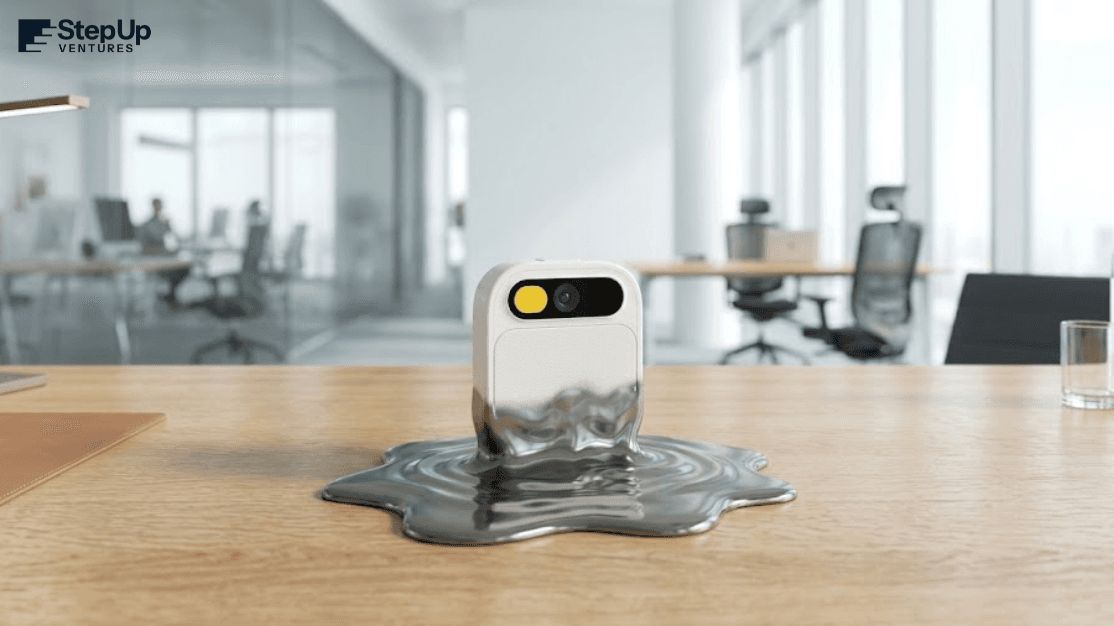
Countless startups chase shiny objects instead of execution. Humane Inc. is the most expensive modern lesson in what happens when hardware ego overrides operational reality. They raised massive funding and lots of eyebrows, only to crash spectacularly and end up in a fire sale.
Forcing AI into a box is a fatal operational error. Let's see what happened.
The Brutal Reality of an $850 Million Collapse
To understand the scale of this misfire, let's take a look at the cold, hard numbers. These are not just statistics: they are a warning for every founder chasing a "revolutionary" vision without a grounded execution plan.
- Total Capital Raised: $230 Million from elite investors.
- Peak Valuation: $850 Million, fueled by hype and ex-Apple pedigree.
- Exit Price: $116 Million (acquired by HP), a fraction of the capital invested.
Humane was founded by former Apple executives with the goal of creating a post-smartphone world. Their flagship product, the AI Pin, was a $700 wearable designed to replace your screen with voice commands and a laser-projected interface. On paper, it was futuristic. In reality, it was a standalone device for a problem already solved by the device in your pocket.
The Core Flaw: AI Isn't Hardware, It's Intelligence on Demand
The central mistake was believing that AI products must be hardware products. In the startup world, momentum is everything. Building hardware is the slowest, most expensive way to find product-market fit.
Humane invested years and hundreds of millions into engineering a bespoke hardware solution. They obsessed over custom chips, battery life in a tiny form factor, and gimmicky features. Meanwhile, the AI capabilities were nothing revolutionary. By the time the AI Pin reached consumers, the technology inside was already lagging behind the software updates of the smartphone ecosystem.
AI thrives as software: agile, updatable, and ecosystem-agnostic. By forcing it into a dedicated gadget, Humane created unnecessary friction. They attempted to compete with the smartphone, the most successful piece of consumer hardware in history. To win that battle, your product cannot just be "as good" as an app. It must provide a 10x improvement in utility. The AI Pin failed this test. It was slower, more prone to overheating, and less reliable than the free AI apps available on any iOS or Android device.
Capital Burned on the Wrong Battlefield
From an operational standpoint, Humane's hardware focus was a capital incinerator. Raising $230M at an $850M valuation gave them runway, but they squandered it on manufacturing nightmares:
- Supply Chain Woes: Sourcing components for a novel device meant delays and high costs, especially amid global chip shortages.
- R&D Misdirection: Instead of iterating on AI models (which can be done cheaply in the cloud), they funneled funds into physical prototypes and testing for durability, ergonomics, and FCC compliance.
- Market Entry Delays: The Pin launched in late 2023 after years of teasers, but by then, competitors like OpenAI and Google had flooded the market with superior app-based AI tools.
This isn't just inefficiency; it's a failure of prioritization. At StepUp Ventures, we embed with founders to ruthlessly simplify operations. Humane could have prototyped their AI as a smartphone app, gathered user feedback in weeks, and scaled without the hardware overhead. Apps allow for rapid updates—fix a bug today, push it tomorrow. Hardware? You're stuck with version 1.0 until the next production run.
Business metrics tell the tale: Post-launch, Humane reportedly sold only about 10,000 units, far below expectations. Returns were high, and negative press amplified the issues. By mid-2024, layoffs hit, and the company shopped itself around, landing in HP's hands for $116M, an 86% drop from peak valuation. That's not an acquisition; it's a salvage operation.
Lessons for AI Founders: Prioritize Software, Execute with Focus
Humane's collapse reinforces a key principle: Startups fail from slow, misguided operations. AI is inherently a software play. It evolves too quickly for rigid hardware to keep pace. If your core value is intelligent assistance, deliver it where users already live: on their phones, in their browsers, or integrated into existing devices.
Imagine if Humane had pivoted early:
- Build an app that leverages phone hardware (cameras, mics, screens) for the same features.
- Test market fit with minimal viable product (MVP) releases, iterating based on data.
- Save capital for AI talent and partnerships, not factories.
The result? Faster momentum, lower burn rate, and a shot at real scalability.
Humane's story is a cautionary tale: Don't let hardware ego derail your AI potential. Focus on what delivers value, cut the bloat, and move with urgency.